Table of Contents
From Solar Jets to Inner-Heliospheric Switchbacks (JET2SB)
From Solar Jets to Inner-Heliospheric Switchbacks (JET2SB) is a 42 month collaborative science project that started in October 2025. JET2SB is supported by the French Agence Nationale pour la Recherche (ANR) under the grant agreement n°ANR-25-CE31-7416.
In the context of the Parker Solar Probe (NASA) and Solar Orbiter (ESA) space missions, JET2SB aims at better understanding the connection between the Sun and its heliosphere and in particular to which extend small to intermediate scale solar activity can induce the ubiquitous magnetic deflections observed in the inner heliosphere.
JET2SB brings together three French solar physics teams with fully complementary expertise, using both space and ground-based observations of the solar atmosphere, in-situ measurements from heliospheric spacecrafts in synergy with comprehensive numerical modelling of the generation and propagation of solar jets from the solar atmosphere to the inner heliosphere. JET2SB is the first project to combine the expertise of these three French laboratories:
• French-Spanish Laboratory for Astrophysics in Canaries (FSLAC): observations of the solar atmosphere, most notably with the THEMIS solar telescope instrument.
• Laboratoire de Physique des Plasmas (LPP): 3D MHD numerical modelling of active events in the solar atmosphere and inner-heliosphere.
• Laboratoire de Physique et Chimie de l’Environnement et de l’Espace (LPC2E): in-situ measurements in the inner heliosphere with PSP and SolO.
Summary
During its unprecedented approaches of the Sun, the Parker Solar Probe (PSP, NASA) mission has made the puzzling discovery of very frequent and abrupt deflections of the magnetic field, the switchbacks (SBs) in the solar wind. Because of their ubiquity in the inner heliosphere, SBs are considered as a key ingredient on the complex generation mechanisms of the solar wind. A family of scenarios place the origin of these event in solar jets, an intermediate-scale form of solar activity occurring continuously at the base of the Sun’s atmosphere. The objectives of JET2SB are to investigate how solar jets can induce the formation of SBs and whether/how they participate to the generation, acceleration and structuration of the solar wind.
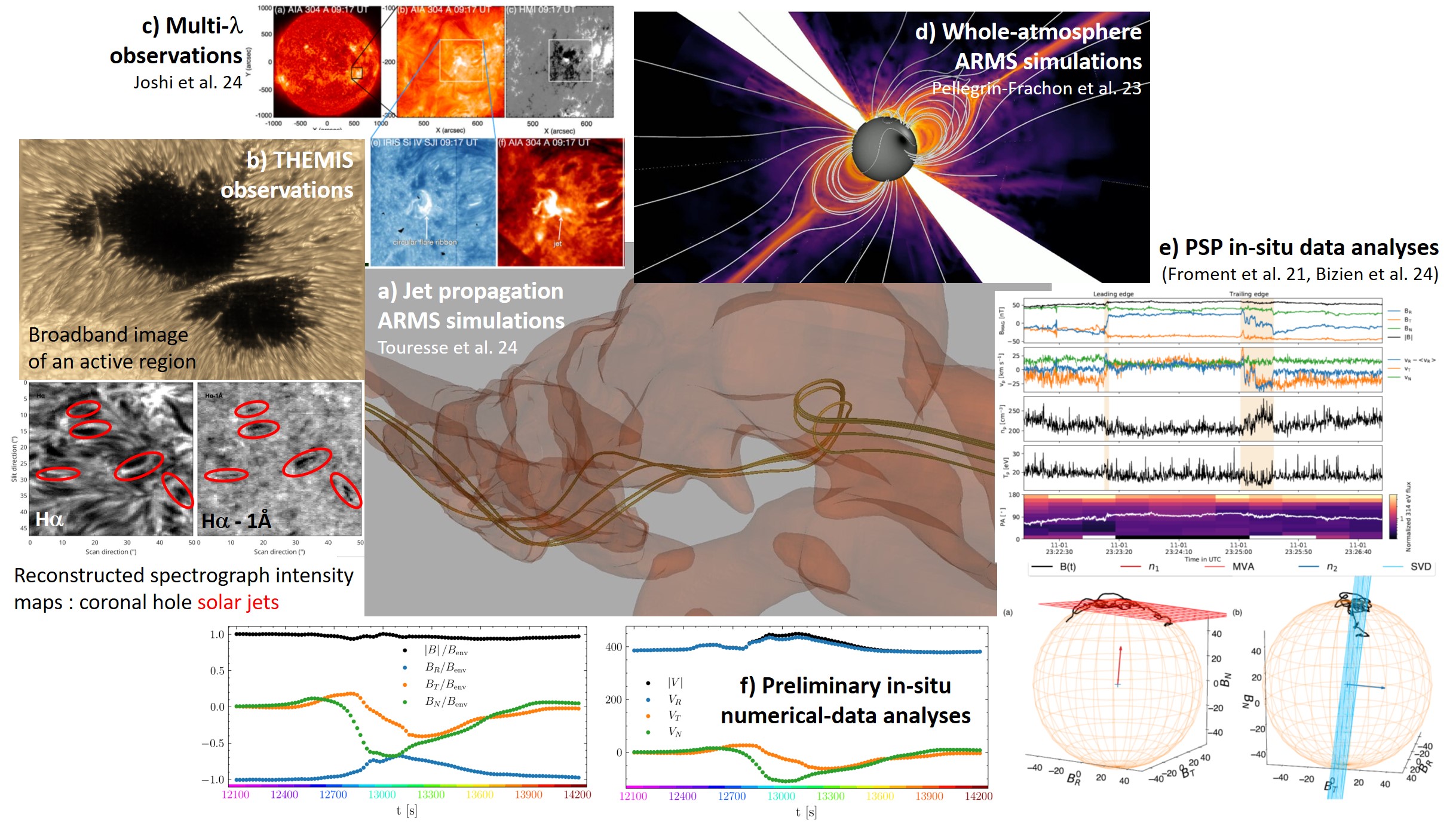
The JET2SB project will build on the complementary expertise of three different French solar physics teams and assets, using both space and ground-based observations of the solar atmosphere, most notably using the renewed THEMIS solar telescope, in-situ measurements from PSP, in synergy with comprehensive 3D MHD numerical modeling of the generation and propagation of solar jets from the solar atmosphere to the inner heliosphere. New observations of the solar atmosphere will be used to better understand the properties of jet-like events, as well as constrain numerical models. The deterministic link between solar observations and inner-heliosphere measurements will be done thanks to 3D MHD simulations of the propagation of jets. They will produce synthetic in-situ measurements to be compared with observed ones. This will allow for a breakthrough in the interpretation and understanding of in-situ observations of SBs, in which the 3D context is absent.
JET2SB will not only strengthen the French expertise in a highly competitive field, but also put it at the forefront of projects that aim at better understanding the societal impacts of solar activity, thanks to a better comprehension of the fundamental properties of Sun-Earth relationships.
Project positioning
JETS2B Scientific objectivesThe core working hypothesis of JET2SB, suggested by the previous observations, and theoretically validated by our preliminary simulations, is that solar jets can induce the formation of at least some SBs. The objectives of JET2SB are thus to address the following four key questions:
|
|
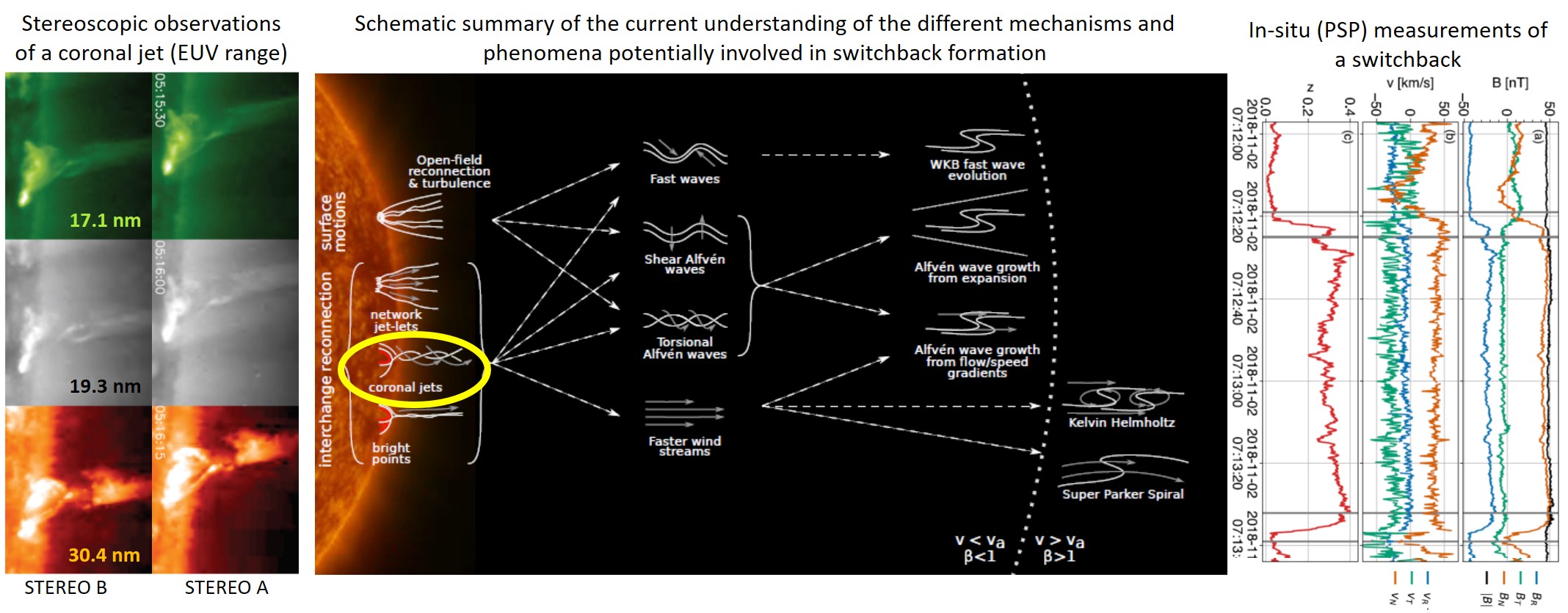
JET2SB expected resultsEach of the three work-packages of JET2SB aims at lifting these present scientific and technical barriers. For these, JET2SB will combine in a synergistic way three methodological approaches: imaging, spectroscopic and spectropolarimetric solar observations; 3D MHD numerical modelling; and in-situ space plasma data analysis. We thus propose the following methodologies:
Overall, as a fundamental science research project, JET2SB will lead to the production of advanced knowledge in Sun-Earth-relationships physics with as main immediate deliverables peer-reviewed scientific publications. JET2SB will also have middle and long-term impacts on the related topic of solar wind origins, the exploitation of upcoming coronal observations instruments and the applied discipline of space weather. In terms of research strategy, the project will put the JET2SB partners, and thus France, in a pole position to carry further researches on the connections between the Sun and the heliosphere. |
|
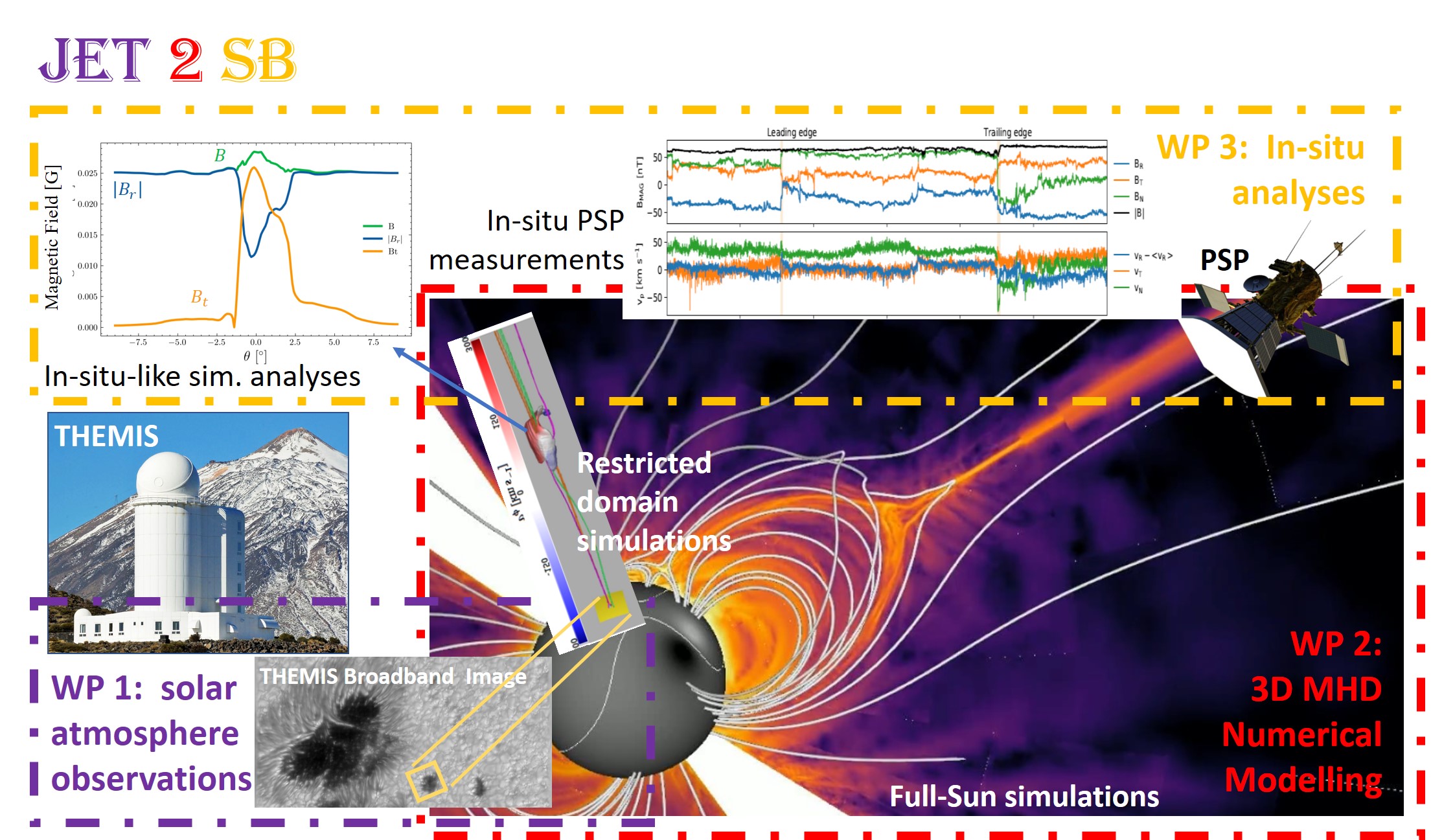
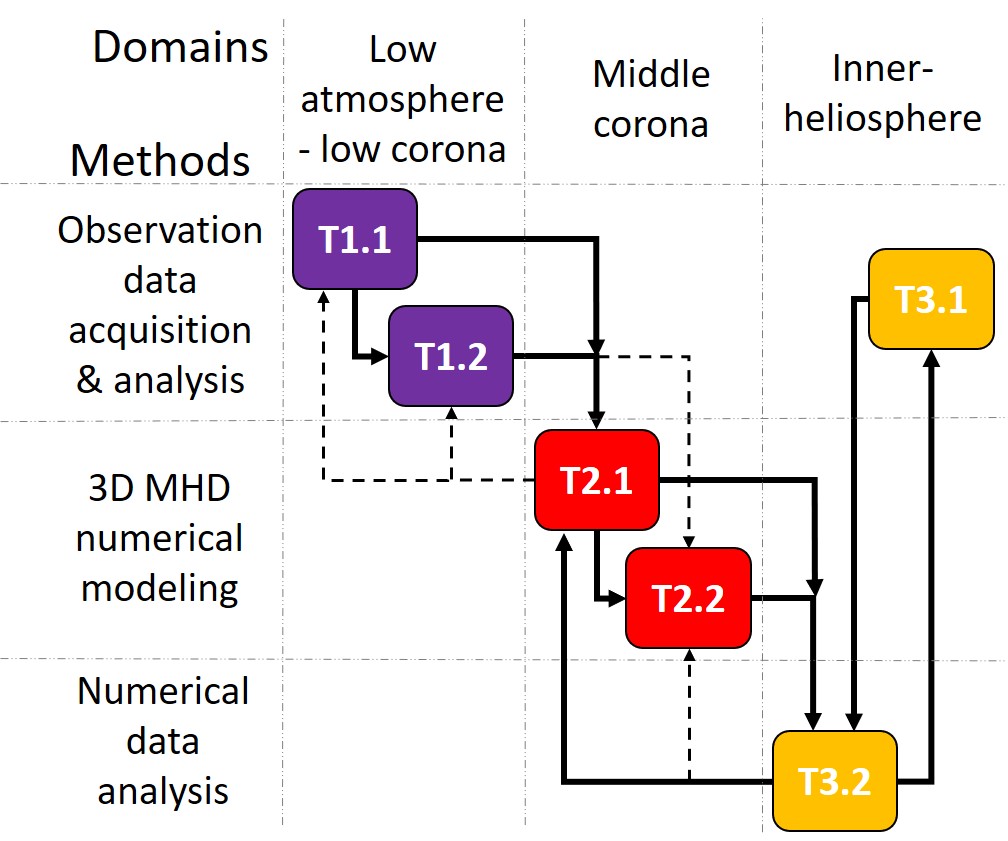
JET2SB project organisationThe JET2SB project is organized in three scientific work packages (WPs), as illustrated in Figure XX, with a summary diagram illustrating the links between the different tasks. Work Package 1 (WP1) - Observations of jet-like events in the solar atmosphereWP1, FSLAC lead, aims at providing unprecedented observations, from both space and ground based instruments, of the jet sources that can eventually lead to SBs. That will permit both directly a better understanding of the properties and physics of these events, as well as constrain the numerical models to be used in WP2. Work Package 2 (WP2) - 3D MHD numerical modelling of the propagation of solar jetsThis second WP, LPP lead, is the backbone of the JET2SB project, as its objective is to permit to link solar atmosphere observations to inner-heliosphere measurements thanks to 3D MHD simulations of the propagation of coronal jets. The simulations will build-up on the observational constraint coming from WP1 and provide to WP3 synthetic in-situ measurements. The simulations will be mainly using the 3D MHD numerical solver ARMS, which has extensively exploited in the last decade by JET2SB team members. Two modelling efforts shall be carried with different numerical domains. The restricted domain simulations simulations, less numerically expensive, will permit to explore the parameters space. They also constitute test-beds for the whole-atmosphere simulations. Because of the much larger domain extend, whole-atmosphere simulations are numerically expensive, in particular as they require long pre-relaxion runs. Work Package 3 (WP3) - In-situ measurements of switchbacks/solar jets signaturesComparison of the in-situ magnetic field and fluid measurement with the in-situ-like analyses of the simulation’s outputs will be carried out in WP3, LPC2E lead. Doing so, it will be possible to discriminate the WP2 simulations (and set-ups) that induce realistic SB signatures from those which don’t. The main objectives of WP3 is thus to provide forward constraints on the jet models, in order to iteratively reach a propagation model of solar jets able to account for diverse in-situ SB properties. |
|
Results and data accessIn construction THEMIS observationsNumerical simulationsIn-situ measurements |