
This is an old revision of the document!
Table of Contents
Page in construction ; Last Update September 2026
THEMIS data products and accessSummaryCurrently, THEMIS provides 4 types of level 1 data products : Theses images are the direct outputs of the different cameras that equip THEMIS at different point of the optical path. Their production is detailed on the THEMIS technical information page, with informations about the possible options available to the users. THEMIS data are the property of property of CNRS-THEMIS under a Creative Commons CC-BY 4.0 license. The data are freely available, however there is unfortunately no catalogue nor webservers to directly access the data. Access to specific datasets can be done by contacting the THEMIS team: themis.team@themis.iac.es. |
|
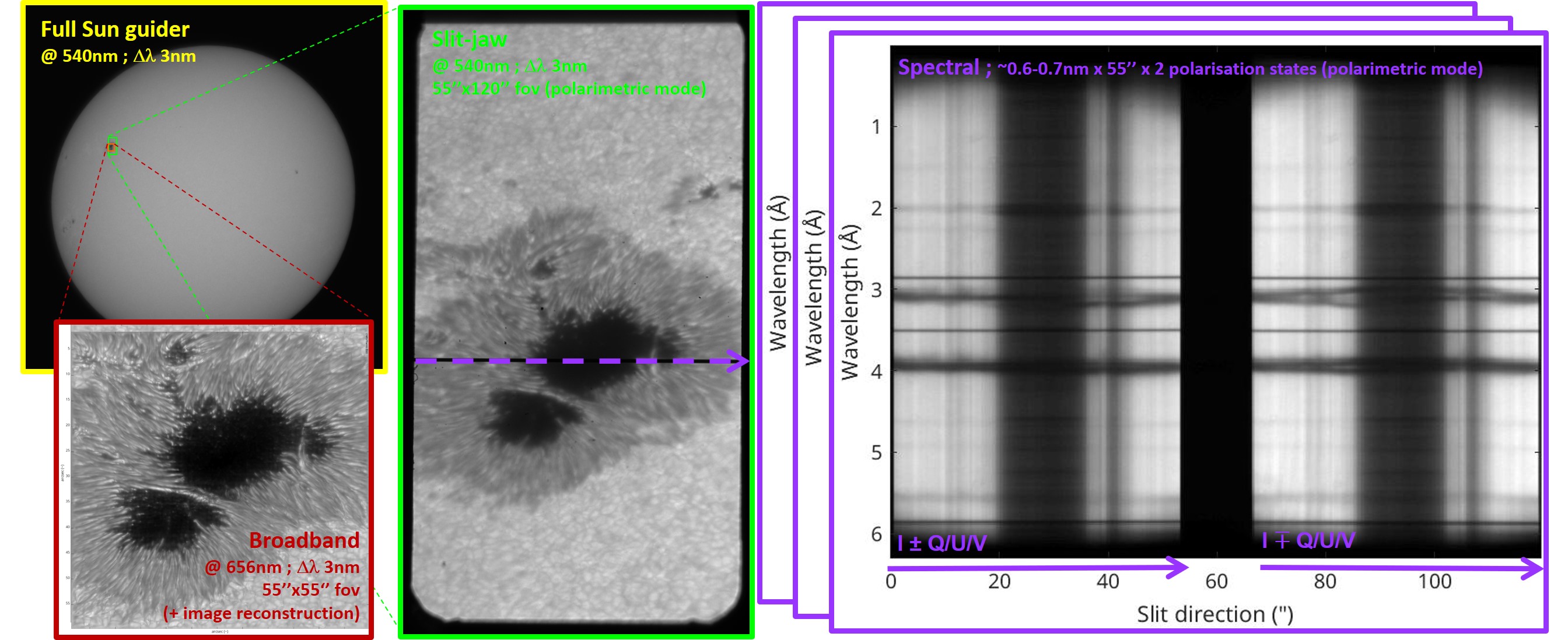
Data products examplesFull-Sun guider imagesThe full-Sun guider images are mainly to provide context to the observations. They correspond to photospheric observations. They are broadband images taken in the green continuum, around 540 nm, with a bandpass of 10nm. They are not meant for pure scientific analysis. Images are provided as a .png files and have a size of 2000×3000 pixels². |
|

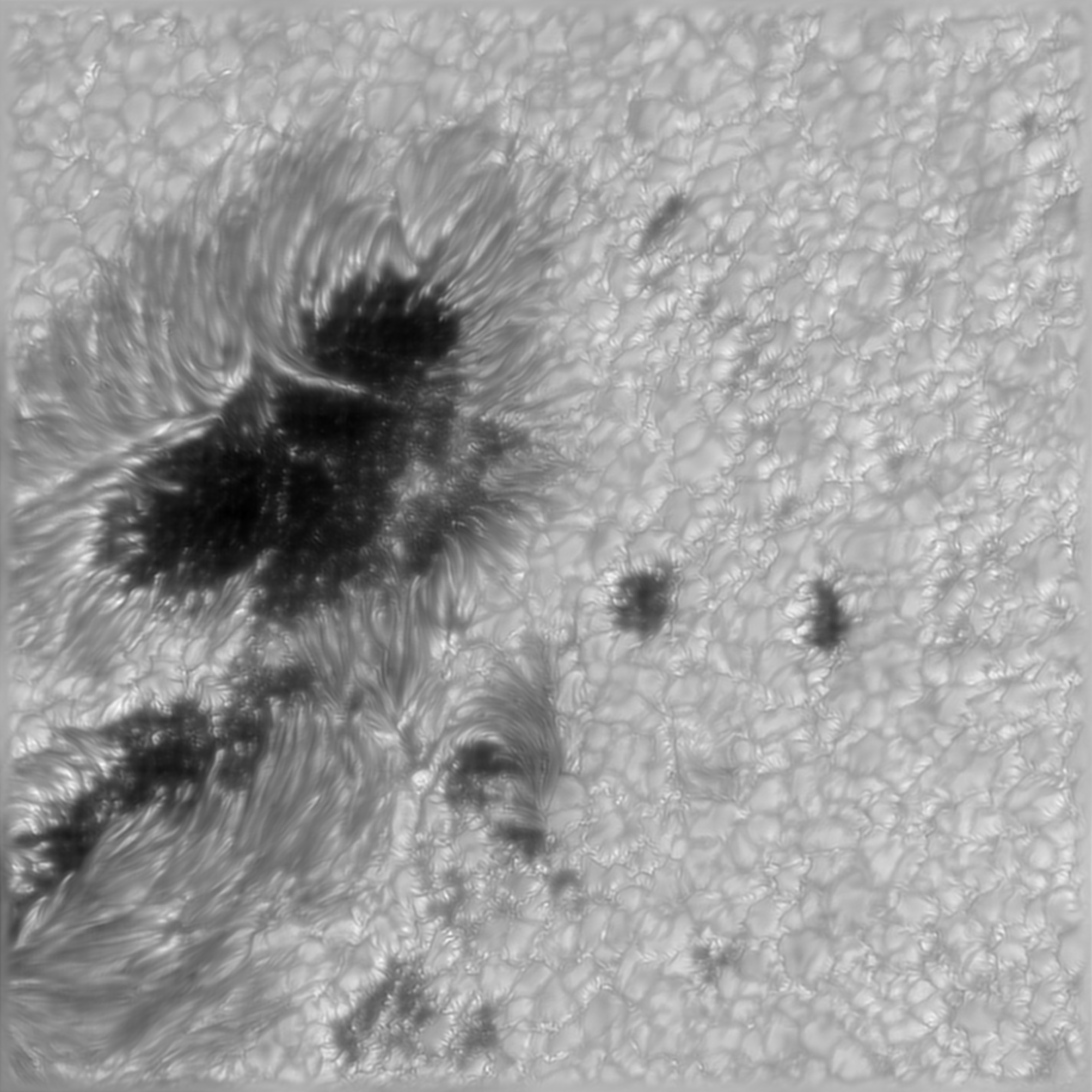
Broadband images (BBI)The BBI camera offers a broadband high-resolution image with a square field-of-view of about ~55”x55“. Presently the images are taken with a broadband red filter, with a ~3nm passband centred around 656 nm. BBI images thus corresponds to visible-light red continuum images. The images are 2000 x 2000 pixels, hence with pixel resolution of about 0.0275“/pixel. They are primarily provided as .fits files. |
|
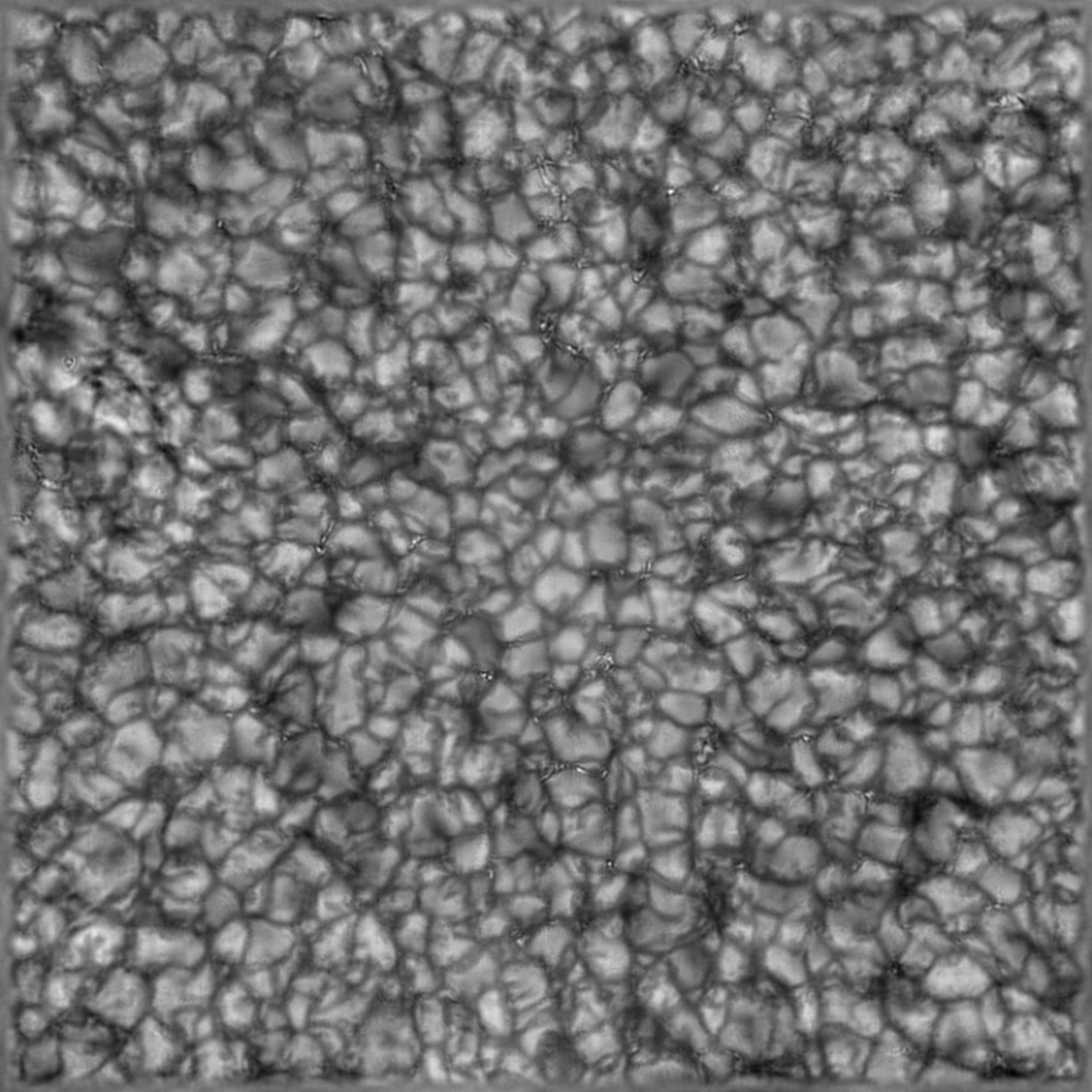
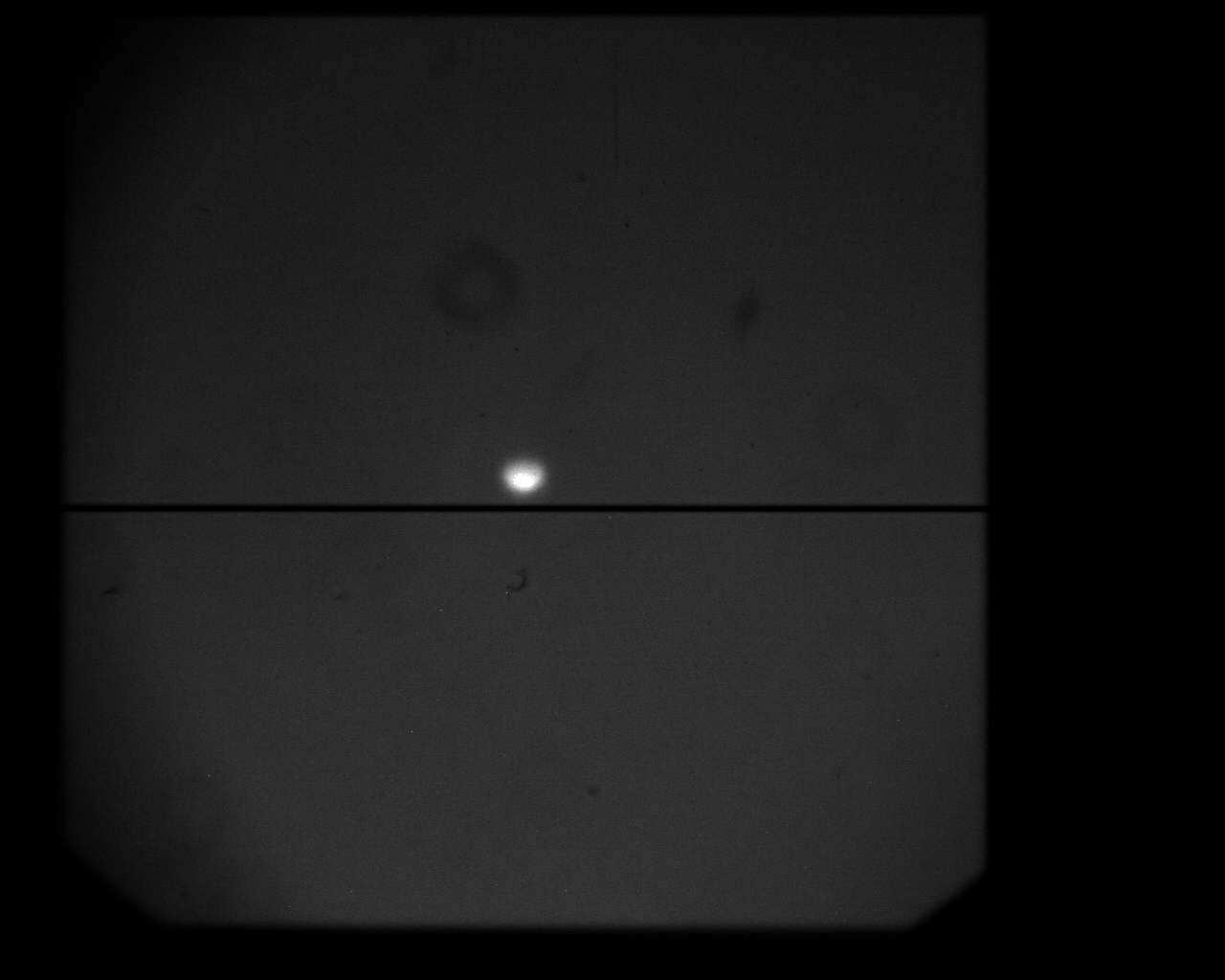
Slit-jaw context images |
Planetary configuration (Mercury)
Solar configuration (no polarisation) |
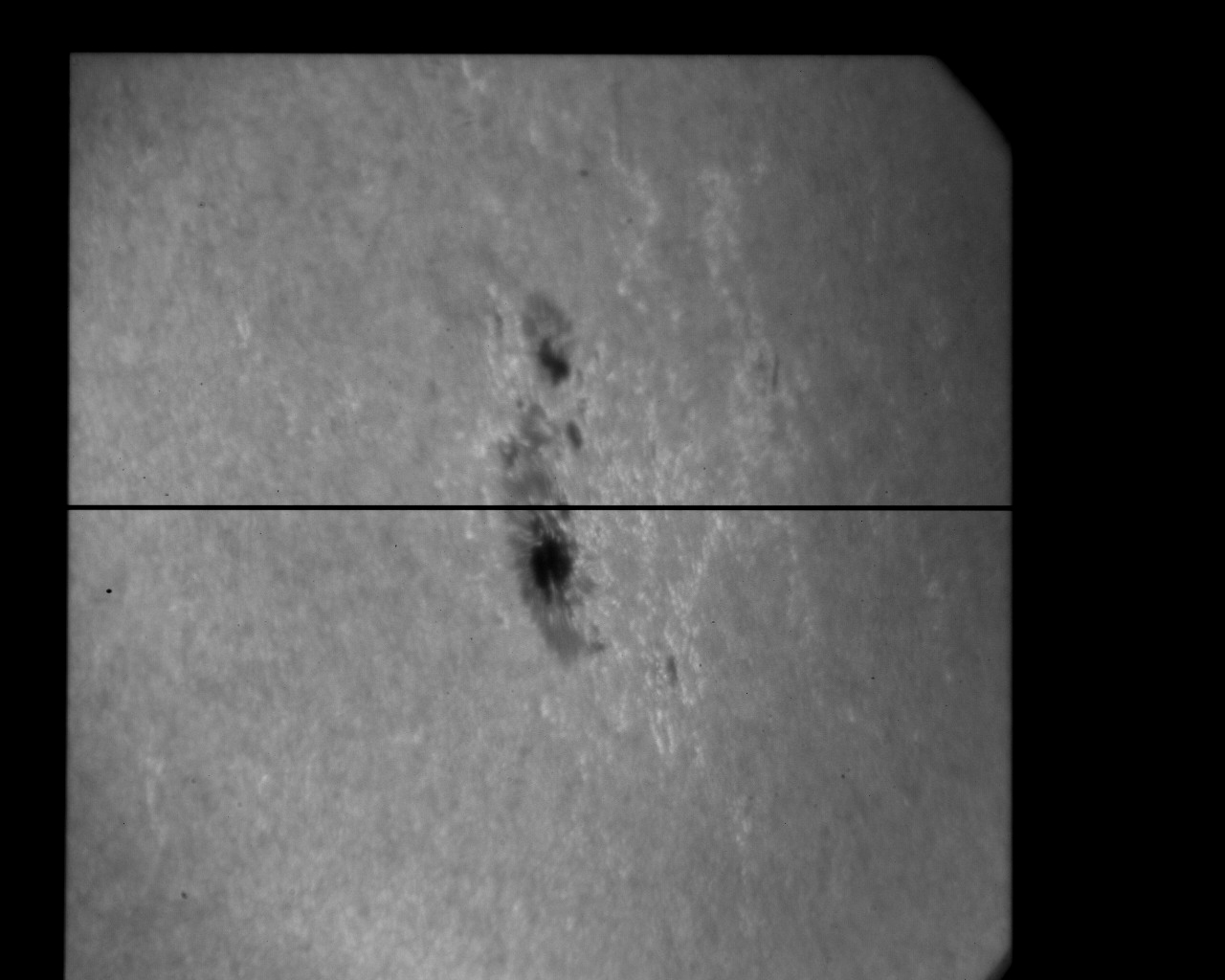
Spectral imagesThe MTR observation mode allows multi-line spectro-polarimetric observations. The available spectral cameras allows for simultaneous observation of a combination of up to 6 wavelengths. However observers usually limits their analysis to 3-4 wavelength. Available wavelengths are currently in the range [430-870] nm. Available combinations of wavelength depends on the actual position of the diffracted spectra at the exit of the spectrograph. The polarimeter is optimized for 6250Å and 4250Å. For non polarized observations, for each channel, at each time, the dataset consists 2D image, with a variable wavelength across the field of view in one direction, and the spatial direction along the slit in the other directions. Each channel is centered on a different wavelength across the line profile. Datas examples : |
|
DATA Access
THEMIS data are the property of property of CNRS-THEMIS under a Creative Commons CC-BY 4.0 license.
The data are freely available, however there is unfortunately no extensive and complete catalogue nor webservers to directly access the data. Some historical heritage datasets can be retrieved form some archive
Access to specific datasets can be done by contacting the THEMIS team: themis.team@themis.iac.es.
THEMIS heritage data
The full archive until 2014 is stored on DLT tapes at the telescope. We do have a functional tape reader but no usable software to run it.
We maintain an incomplete archive of years 2009, 2010, 2012, 2013, 2014 on HDDs. Listing of what's available:
THEMIS databases and related
- THEMIS fits headers log (alpha version unmaintained)
- Themis daily log (Old version, obsoleted)
- BASS 2000 (Tarbes) Portal
- BASS 2000 (Tarbes) Solar data query page
Other solar databases and virtual observatories
- JHelioviewer visualisation software (to download and install)
- HELIO notice “Heliophysics Integrated Observatory”


