
This is an old revision of the document!
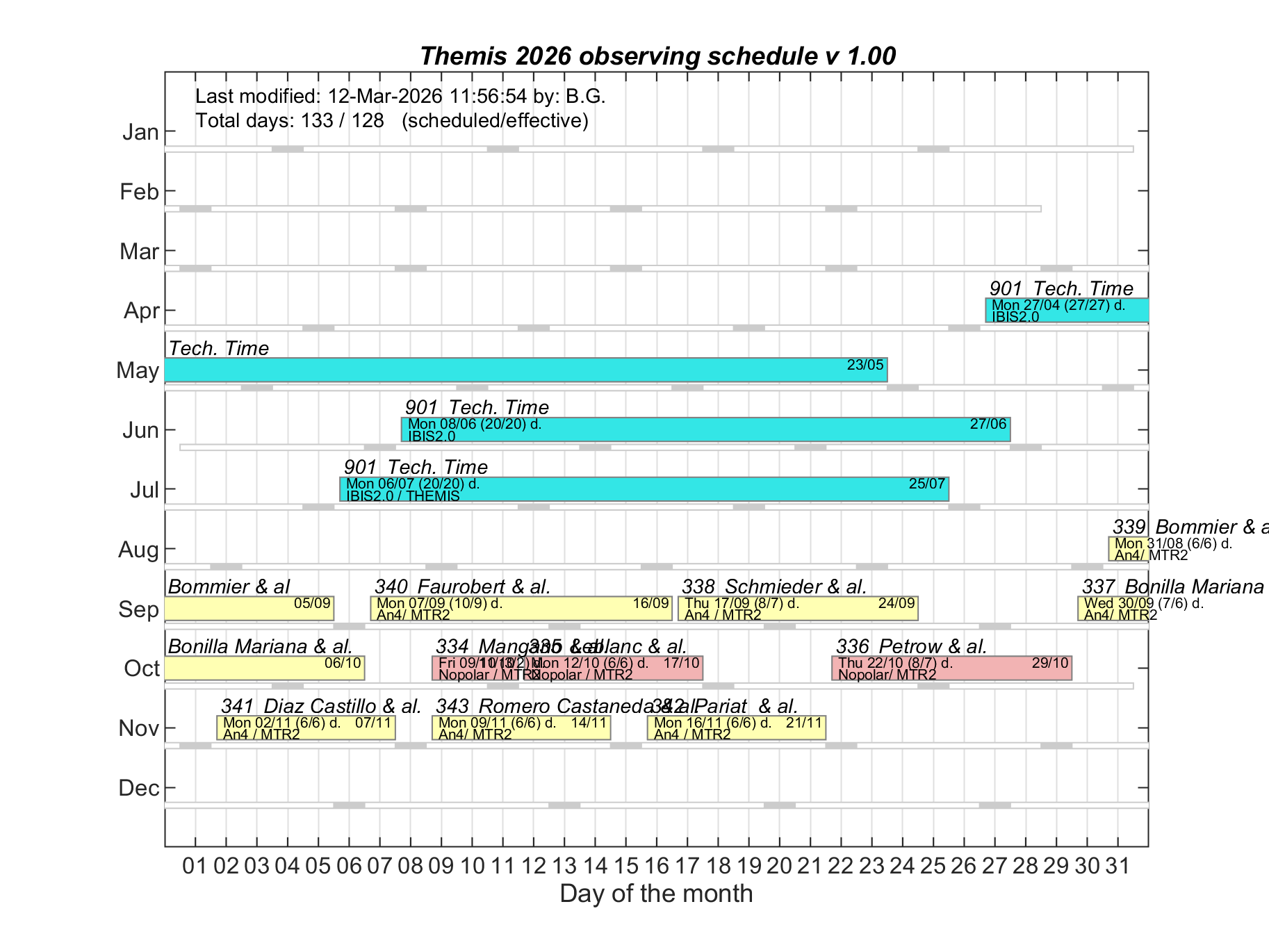
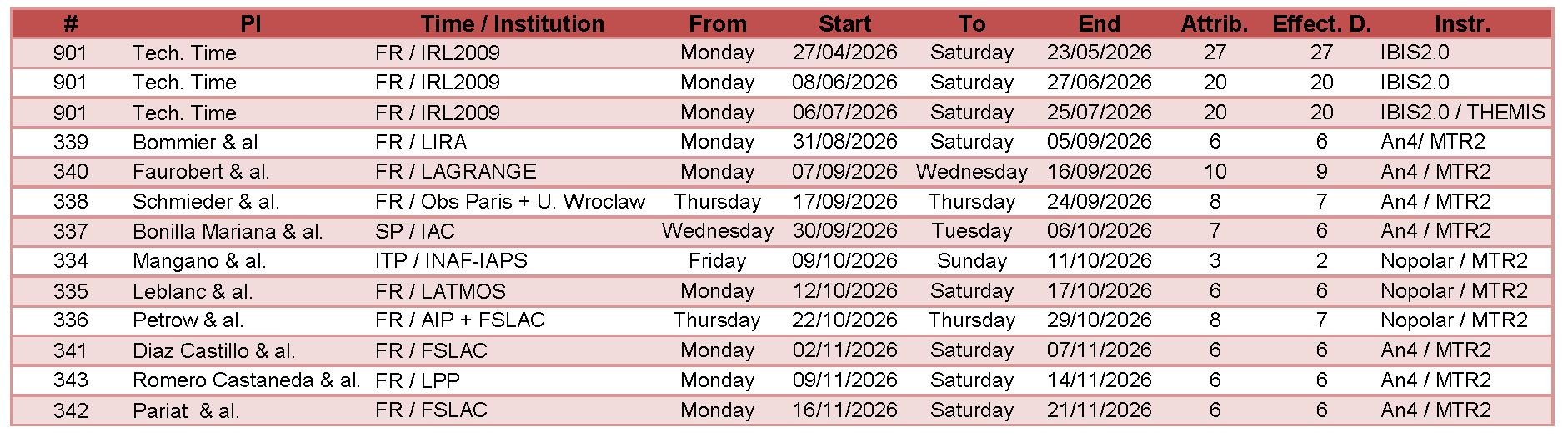
2026 observing campaignThe call for the 2026 observing campaign is now closed! THEMIS 2026 observing campaign will take place approximately from early September to mid-November, 2026, lasting for about 70 days. The 1st half of 2026 shall be mostly dedicated to the on-going installation and commissioning of the Italian IBIS 2.0 spectro-imager. 2026 campaign scheduleThe 2026 campaign shall observe the following schedule:
|
|
==== Available instrumentation for 2026 ==== === Adaptive optics === TAO is available and tested over sunspots and granulation with good results over significantly long periods of time (seeing dependent). * A slowed-down (100Hz) version of the same system can be used to stabilize Mercury. * While it is not possible to use TAO over the solar limb (or for neighboring prominences), during the 2025 campaign, tests have been carried to observe prominences while TAO was focused on granulation in an offset disc region of THEMIS FOV. Even though the TAO isoplanatic region is located far from the targeted prominence, TAO nonetheless provided significant improvements, as shown in the August THEMIS image of the month. === MTR2 in spectroscopy mode === In this mode, up to 4 EMCCD Andor iXon cameras (512×512 pixels) and up to 2 (recent) Andor Zyla (2kx2k pixels) cameras are available. All 6 cameras can be setup and used at the same time (with their respective specifications), in accordance with the SP2 output physical limitations. More information about the MTR2 spectrograph. === MTR2 in spectropolarimetry mode: === THEMIS polarimetric analysis scheme is based on a full-Stokes analyzer located at the F1 prime focus. For any solar polarization state to measure, the output of the analyzer is made of dual superimposed complementary linear polarizations. Thanks to THEMIS “polarization friendly” new optical scheme, this output travels through the telescope and arrives unperturbed on the spectrograph cameras (cf. information about MTR2 spectrograph). Just in front of the camera, a Wollaston splitter separates the beam into complementary Stokes components to form the spectral focal plane. THEMIS own three Wollaston, hence 3 cameras/3 wavebands at most can be simultaneously observed with polarimetric signal, among the 6 spectral cameras that THEMIS proposes. It is however possible to combine polarimetric and non-polarimetric cameras. Regarding the available analysis software: === Broadband imaging (BBI) context camera: === THEMIS BBI fast camera (40 frames/s), is running concurrently with the spectrograph. Current setup is for the continuum around 656 nm (red), but can be optionally changed to G-band or other. === Available analysis softwares === * Knox-Thompson image reconstruction for BBI * Reconstructed spectral map quick-looks for on site analysis, to be adapted to specific wavelength. * Stokes map quick-looks * Thanks to V. Bommier, a basic magnetic field inversion software package (running locally in IDL) is also available. /* == 2024 known problems (and solutions) == * The optical diffusion problem that was detected in Sept 2024 (mostly affecting the He D3 observations) has been identified and corrected (November 2024). * The data acquisition issue in polarimetric modes was tracked down to a bad synchronisation between the analyzer rotation and the camera exposure. This has been solved at the cost of slowing down the acquisition loop (roughly a factor 2 slower). This issue has been affecting all the September 2024 runs. */


