This is an old revision of the document!
Table of Contents
THEMIS MulTi-Ray spectrograph (MTR2)
MTR2 is the advanced version of the original MulTi-Ray spectrograph of THEMIS. MTR2 enables the production of high-spectral resolution spectrograms simultaneously in different wavelengths. This enables the study of different physical properties of the distinct layers of the solar atmosphere.
MTR2 spectrograph has an effective Resolving Power, R, of 300 000 to 400 000, mainly limited by the entrance slit width. Typical spectral resolution of MTR2 for a 0.5 arcsec slit width for different lines are:
- 4861.3 Å ; δλ= 19 mÅ
- 5875.7 Å ; δλ = 27 mÅ
- 6302.0 Å (Fe I doublet) ; δλ= 25 mÅ
- 6562.8 Å (Hα) ; δλ = 30 mÅ
Schematics of MTR2
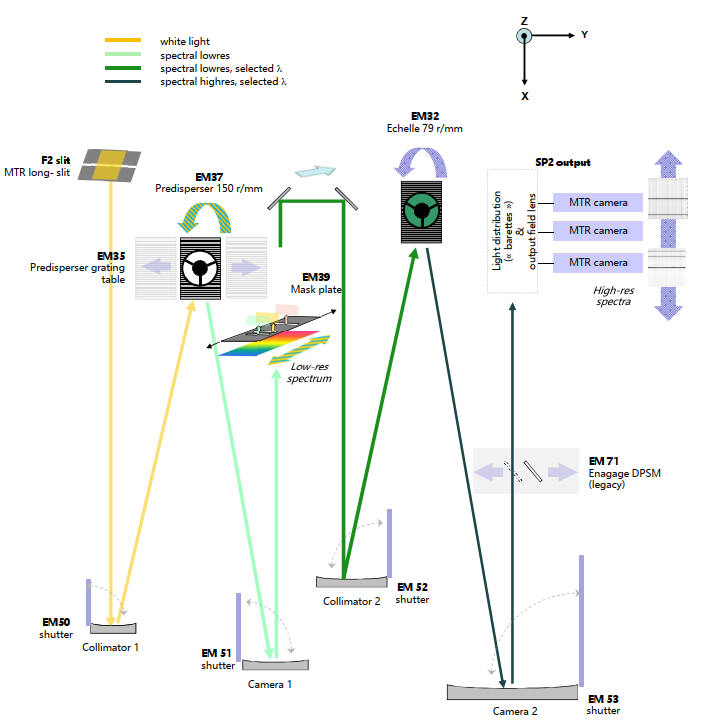
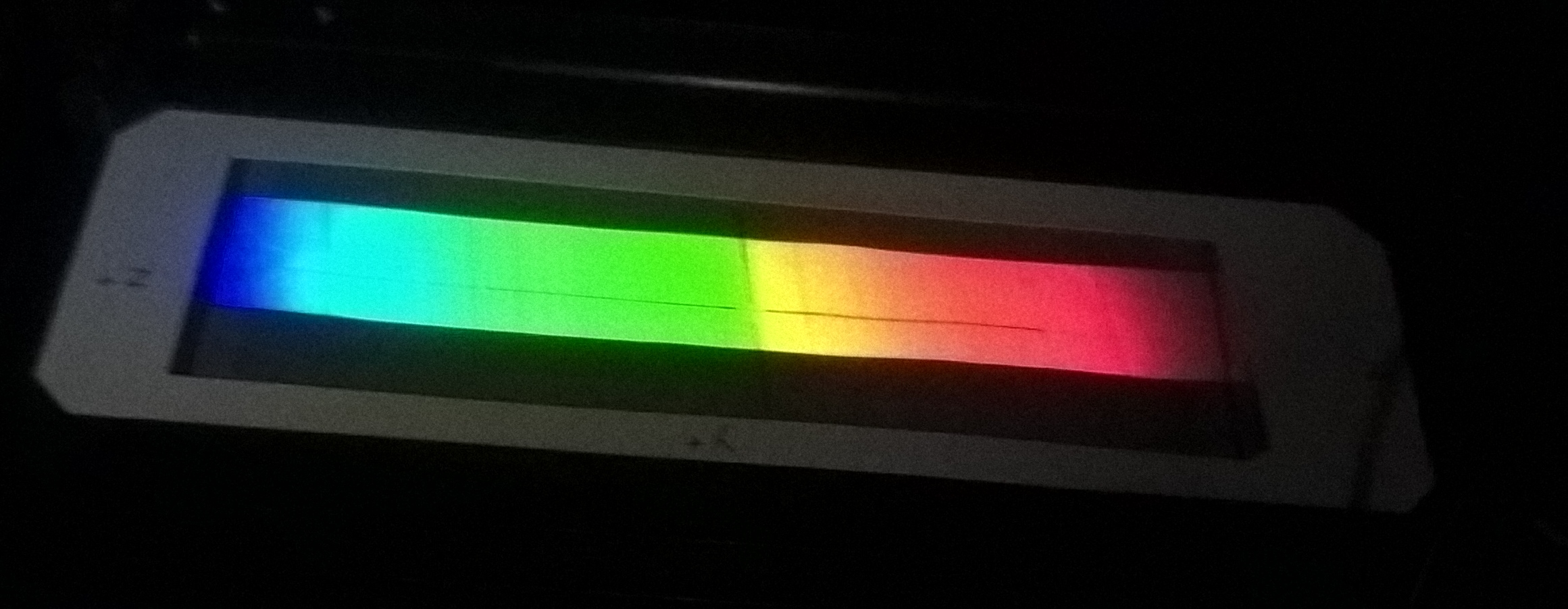
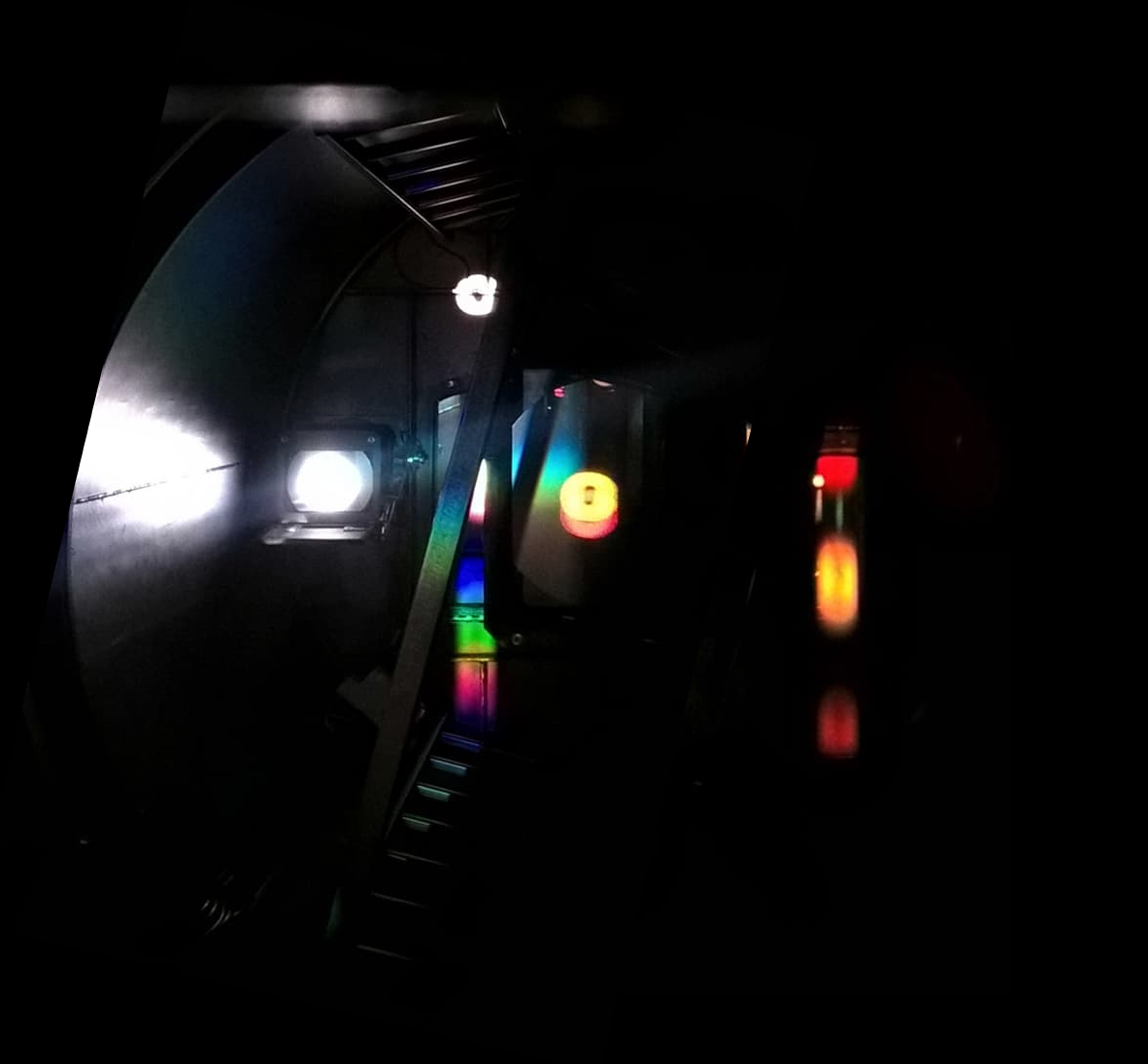
MTR2 is made of a predispersor (“SP1” first one on the left part), forming a low resolution spectrum on the wavelength selector (so called the “mask plate”). From there, only the selected bandwiths travel to the high-resolution echelle spectrograph (right part), ending over the MTR cameras at the SP2 output (one bandwith per camera). The optical layout along Y is fixed (no changes, never). The ruling of the gratings are along Y only and the dispersion of both spectra is along Z only. The entrance slit is fixed (but for its width), and such are the collimators and camera mirrors. The moving parts are:
In short:
Data and formulae for the MTR2 can be found in the following document: Spectrograph simulation toolsThese tools allow the observer to quick check the feasibility of a setup
Observers can also check the list of existing available mask plates to have an idea of readily available combination. Solar spectra resources
|
|